Ironclad
  • Construction Services
    • General Contracting
    • Construction Management
    • Design-Build
    • Ground-Up Construction
    • Renovations
    • Emergency Restorations
  • Industries
    • Commercial Buildings/Offices
    • Education
    • Manufacturing and Industrial
    • Healthcare
    • Hospitality
    • Government/Municipalities
  • Federal Contracting
  • Projects
    • Department of Veteran Affairs
  • About Us
    • Blog
    • Safety
    • Leadership Team
    • Areas We Serve
      • Springfield
      • Boston
      • Albany
      • Raleigh
      • Columbia
      • Manchester
      • Westhaven
    • Careers
  • Contact
  • (413) 693-1371
  • Menu Menu
  • Link to LinkedIn

ADA Compliance Construction: Accessibility Requirements in Commercial Construction

ADA compliance construction is one of the most consistently misunderstood obligations in commercial building and renovation work. Many owners and facility managers treat accessibility requirements as an afterthought, a final inspection checklist item rather than something built into the design and planning phase from the start.

The difference between those two approaches shows up in project cost, timeline, and in some cases significant legal exposure.

What the ADA Requires in Commercial Construction

The Americans with Disabilities Act establishes baseline accessibility standards for facilities that serve the public. ADA requirements for commercial buildings fall into two primary categories: new construction and alterations to existing facilities. For new construction, the requirement is clear. Buildings first occupied after January 26, 1993 must fully comply with ADA standards for accessible design, and structural impracticability is a narrow exception that applies almost exclusively to specific multi-story conditions. ADA compliance construction for new commercial facilities is not optional, and the standards govern everything from site access to interior finish details.

The ADA operates through multiple titles depending on the facility type. Title II covers state and local government facilities. Title III covers places of public accommodation and commercial facilities, which includes most private commercial buildings: office complexes, retail centers, healthcare facilities, hotels, educational institutions, and similar properties. For the commercial general contractor and the facility managers who hire them, Title III is the operative framework for understanding compliance obligations.

For renovations and alterations, the requirements are more nuanced and catch many commercial owners by surprise.

Where Accessibility Gets Built Into a Commercial Project

ADA building requirements touch nearly every dimension of a commercial project, from the site itself to the interior finishes. Understanding where compliance lives helps owners and facility managers ask the right questions during preconstruction planning.

Site and Parking Accessibility

Accessible parking is one of the first ADA compliance construction items addressed at the site planning stage. The number of required accessible spaces scales with the total parking count, and van-accessible spaces have specific dimensional requirements for access aisles and vertical clearance. Accessible routes must connect parking areas to building entrances without requiring users to cross active vehicular traffic lanes wherever the site design allows.

Building Entrances and Path of Travel

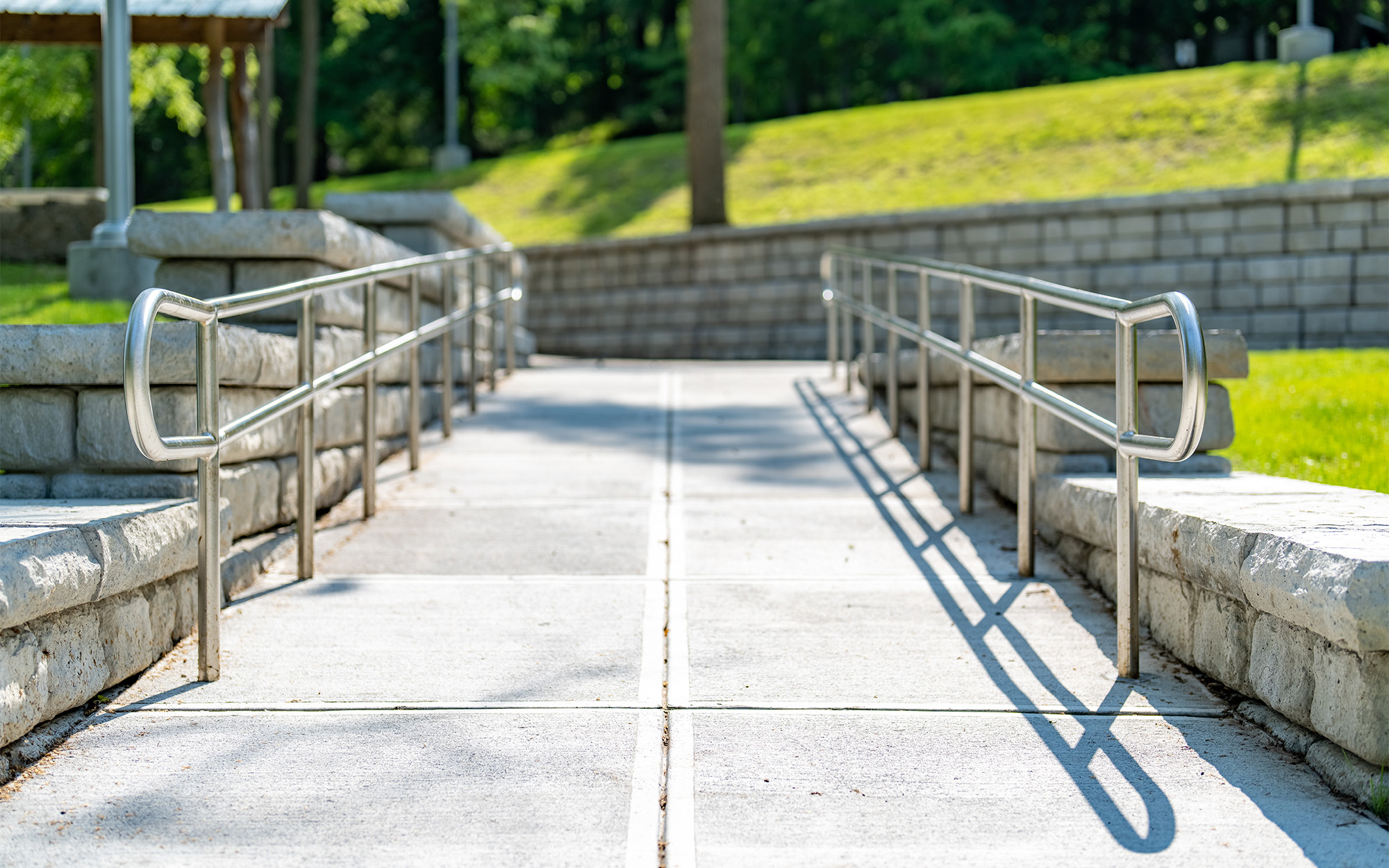
At least one primary building entrance must be fully accessible. Where revolving doors or turnstiles serve as the main entry point, an adjacent accessible route must also be provided. Thresholds, door hardware, and door opening force are all regulated under the standards. The path of travel from the accessible entrance to all primary function areas must meet slope, width, and surface requirements throughout the building.

Interior Elements

Inside the building, ADA standards for accessible design govern corridor widths, door clearances, reach ranges, counter heights, elevator specifications, and restroom configuration. Each of these is a design decision. Resolving them on the drawing board is significantly less disruptive and less expensive than addressing them after framing is complete.

ADA Requirements in Renovation and Alteration Work

Renovations are where ADA compliance construction gets most complicated for commercial building owners. Many assume that existing buildings are grandfathered out of accessibility requirements. They are not. While facilities built before 1993 are not required to bring every element into full compliance immediately, any renovation that touches a primary function area must comply with current ADA requirements for commercial buildings, and the path of travel obligations extend beyond the renovated space itself.

Under the ADA, altering a primary function area also triggers an obligation to make the path from the building entrance to that area accessible, including restrooms, telephones, and drinking fountains along that route. This path of travel requirement is capped at 20 percent of the cost of the original alteration, which provides some budget protection, but the requirement itself is non-negotiable.

A commercial general contractor experienced in renovation work will identify these obligations during preconstruction and account for them in the project budget and schedule before work begins. Discovering the path of travel requirements mid-construction is almost always more expensive than planning for them before the first wall is opened.

Discover how ADA compliance construction requirements intersect with the specialized regulatory demands of healthcare construction and what those layers of compliance mean for your next commercial project.

Learn More

Common Areas Where ADA Building Requirements Are Missed

Despite established ADA compliance construction standards, certain elements are consistently underbuilt or overlooked on commercial projects. These are the areas where compliance gaps most frequently appear.

  • Restrooms: Commercial restroom accessibility requirements are detailed and specific, covering turning radius, grab bar placement, fixture heights, door swing clearance, and lavatory knee clearance. Restrooms are among the most frequently cited areas in commercial ADA compliance reviews.
  • Parking Lots: Accessible space counts, access aisle dimensions, and required signage are frequently underbuilt in renovation projects where the parking field was not included in the original scope.
  • Door Hardware: Lever-style or push hardware is required throughout accessible routes. Knob hardware does not meet ADA standards, and door opening force and closing speed are regulated elements that can be cited without any renovation work taking place.
  • Signage: Room identification signs must be mounted at specified heights and include Braille. Directional signage to accessible routes and restrooms is required where those routes are not self-evident to building visitors.
  • Accessible Routes: Exterior path slope requirements are specific, and minor grade changes can produce a non-compliant condition if the site design does not account for them during planning.

Why Preconstruction Planning Is the Right Approach

The cost to correct an ADA compliance construction issue follows a consistent pattern across commercial projects. Catching a problem during schematic design costs almost nothing to fix. Catching it during active construction costs significantly more. Discovering it after the certificate of occupancy is issued can mean removing finishes, reconfiguring plumbing, or reworking site elements that were just installed.

ADA compliance construction work addressed during preconstruction is simply design. The same work addressed after a project closes out is remediation, and the costs reflect that difference.

Beyond the cost argument, early accessibility planning also creates documentation that supports the owner’s position in the event of a complaint or compliance review. A project file that shows accessibility requirements were addressed in preconstruction, incorporated into design drawings, and verified during construction is a substantially stronger record than one where compliance decisions were made informally during the build. Experienced commercial general contractors maintain this documentation as part of standard project records.

How Ironclad Approaches Accessibility in Commercial Projects

Ironclad Services is a commercial general contractor with experience across ground-up builds, occupied-space renovations, healthcare facilities, government buildings, and tenant fit-outs throughout New England. ADA compliance construction is not handled as a separate deliverable at Ironclad. Accessibility requirements are identified, scoped, and priced during the preconstruction process so that owners have a clear picture of what compliance requires before design development begins.

Understanding ADA requirements for commercial buildings is part of what allows Ironclad to deliver projects that pass inspection the first time and serve all building users without remediation after the fact. If your commercial project involves renovation of a primary function area, new ground-up construction, or a build in a regulated environment, the accessibility conversation belongs at the start. Reach out to Ironclad to talk through what your project requires.

Share This Post

  • Share on Facebook
  • Share on X
  • Share on Pinterest
  • Share on LinkedIn
  • Share on Tumblr
  • Share on Vk
  • Share on Reddit
  • Share by Mail

More Like This

How Construction Technology Trends Are Changing Commercial Builds

Commercial Construction
https://www.ironcladservices.com/wp-content/uploads/2026/09/Construction-Technology-Trends-for-Commercial-Builds.jpg 1250 2000 Abstrakt Marketing /wp-content/uploads/2022/11/IroncladlogoBW-300x74.png Abstrakt Marketing2026-09-10 09:45:412026-09-10 09:45:47How Construction Technology Trends Are Changing Commercial Builds

How to Build a Realistic Commercial Construction Budget

Commercial Construction
https://www.ironcladservices.com/wp-content/uploads/2026/08/How-to-Build-a-Commercial-Construction-Budget-Ironclad-Services.jpg 1250 2000 Abstrakt Marketing /wp-content/uploads/2022/11/IroncladlogoBW-300x74.png Abstrakt Marketing2026-08-25 15:03:412026-08-25 15:03:47How to Build a Realistic Commercial Construction Budget

Sustainable and Strategic Building for the Future

Commercial Construction
https://www.ironcladservices.com/wp-content/uploads/2026/06/Sustainable-and-Strategic-Building-for-the-Future.jpg 1250 1994 Abstrakt Marketing /wp-content/uploads/2022/11/IroncladlogoBW-300x74.png Abstrakt Marketing2026-06-18 08:33:592026-06-18 08:34:04Sustainable and Strategic Building for the Future
Industrial and Warehouse Construction: From Site to Structure

Industrial and Warehouse Construction: From Site to Structure

Commercial Construction
https://www.ironcladservices.com/wp-content/uploads/2026/05/Industrial-and-Warehouse-Construction-From-Site-to-Structure.jpg 1250 2000 Abstrakt Marketing /wp-content/uploads/2022/11/IroncladlogoBW-300x74.png Abstrakt Marketing2026-05-20 07:52:352026-05-20 07:54:15Industrial and Warehouse Construction: From Site to Structure

A Complete Guide to Commercial Construction Projects and Their Phases

Commercial Construction
https://www.ironcladservices.com/wp-content/uploads/2026/04/A-Complete-Guide-to-Commercial-Construction-Projects-and-Their-Phases.jpg 1250 2000 Abstrakt Marketing /wp-content/uploads/2022/11/IroncladlogoBW-300x74.png Abstrakt Marketing2026-04-03 21:22:222026-04-03 21:22:27A Complete Guide to Commercial Construction Projects and Their Phases

The Top 7 Reasons Developers Prefer Design-Build Services for Commercial Projects

Commercial Construction, Design-Build
https://www.ironcladservices.com/wp-content/uploads/2026/03/Why-Developers-Prefer-Design-Build-Services.jpg 1250 2000 Abstrakt Marketing /wp-content/uploads/2022/11/IroncladlogoBW-300x74.png Abstrakt Marketing2026-03-04 16:36:102026-03-04 16:37:21The Top 7 Reasons Developers Prefer Design-Build Services for Commercial Projects

Navigating ESG Requirements in Commercial Construction

Commercial Construction, ESG
https://www.ironcladservices.com/wp-content/uploads/2025/10/Navigating-ESG-Requirements-in-Commercial-Construction.jpg 1250 2000 Abstrakt Marketing /wp-content/uploads/2022/11/IroncladlogoBW-300x74.png Abstrakt Marketing2025-10-31 09:00:222025-10-31 09:01:54Navigating ESG Requirements in Commercial Construction
Design Build Vs. Traditional Construction: Our Analysis

Design Build Vs. Traditional Construction: Our Analysis

Commercial Construction
https://www.ironcladservices.com/wp-content/uploads/2025/08/Design-Build-Vs.-Traditional-Construction-Our-Analysis.jpg 1250 2000 Abstrakt Marketing /wp-content/uploads/2022/11/IroncladlogoBW-300x74.png Abstrakt Marketing2025-08-13 15:51:432025-08-13 15:51:46Design Build Vs. Traditional Construction: Our Analysis
Building permit being reviewed on tablet

Understanding the Construction Permit Process: A Comprehensive Guide

Commercial Construction
https://www.ironcladservices.com/wp-content/uploads/2025/01/Building-permit-being-reviewed-on-tablet.jpg 1250 2000 Abstrakt Marketing /wp-content/uploads/2022/11/IroncladlogoBW-300x74.png Abstrakt Marketing2025-01-13 10:53:032025-01-13 10:53:10Understanding the Construction Permit Process: A Comprehensive Guide
Previous Previous Previous Next Next Next

Categories

  • Commercial Construction
  • Commercial Restoration
  • Construction Scheduling
  • Contractor Selection
  • Damage Assessment
  • Design-Build
  • Disaster Recovery
  • Emergency Restoration Services
  • ESG
  • General Contracting
  • Masonry
  • Pre Construction
  • Regional Strategy
  • Remodel / Renovations
  • Risk Management

Contact Us

"*" indicates required fields

Location

Address

1500 Main St., Suite 2004
Springfield, MA 01115


Get In Touch

Phone
413.693.1371

Email
builders@ironcladservices.com

Construction Services

General Contracting

Construction Management

Design-Build

Ground-Up

Renovations

Emergency Restorations

About Us

Ironclad Services is a full-service commercial construction contractor headquartered in Springfield, Massachusetts. We bring the same level of precision, safety, craftsmanship, and quality to private sector projects large and small as we do the federal contracting work that our reputation was built on.

Learn More
Website by Abstrakt Marketing Group ©
  • Sitemap
  • Privacy Policy
  • LinkedIn
Link to: How Construction Technology Trends Are Changing Commercial Builds Link to: How Construction Technology Trends Are Changing Commercial Builds How Construction Technology Trends Are Changing Commercial Builds
Scroll to top Scroll to top Scroll to top

This site uses cookies. By continuing to browse the site, you are agreeing to our use of cookies.

AcceptLearn more

Cookie and Privacy Settings


How we use cookies

We may request cookies to be set on your device. We use cookies to let us know when you visit our websites, how you interact with us, to enrich your user experience, and to customize your relationship with our website.

Click on the different category headings to find out more. You can also change some of your preferences. Note that blocking some types of cookies may impact your experience on our websites and the services we are able to offer.

Essential Website Cookies

These cookies are strictly necessary to provide you with services available through our website and to use some of its features.

Because these cookies are strictly necessary to deliver the website, refusing them will have impact how our site functions. You always can block or delete cookies by changing your browser settings and force blocking all cookies on this website. But this will always prompt you to accept/refuse cookies when revisiting our site.

We fully respect if you want to refuse cookies but to avoid asking you again and again kindly allow us to store a cookie for that. You are free to opt out any time or opt in for other cookies to get a better experience. If you refuse cookies we will remove all set cookies in our domain.

We provide you with a list of stored cookies on your computer in our domain so you can check what we stored. Due to security reasons we are not able to show or modify cookies from other domains. You can check these in your browser security settings.

Other external services

We also use different external services like Google Webfonts, Google Maps, and external Video providers. Since these providers may collect personal data like your IP address we allow you to block them here. Please be aware that this might heavily reduce the functionality and appearance of our site. Changes will take effect once you reload the page.

Google Webfont Settings:

Google Map Settings:

Google reCaptcha Settings:

Vimeo and Youtube video embeds:

Accept settingsHide notification only