Ironclad
  • Construction Services
    • General Contracting
    • Construction Management
    • Design-Build
    • Ground-Up Construction
    • Renovations
    • Emergency Restorations
  • Industries
    • Commercial Buildings/Offices
    • Education
    • Manufacturing and Industrial
    • Healthcare
    • Hospitality
    • Government/Municipalities
  • Federal Contracting
  • Projects
    • Department of Veteran Affairs
  • About Us
    • Blog
    • Safety
    • Leadership Team
    • Areas We Serve
      • Springfield
      • Boston
      • Albany
      • Raleigh
      • Columbia
      • Manchester
      • Westhaven
    • Careers
  • Contact
  • (413) 693-1371
  • Menu Menu
  • Link to LinkedIn

Government Building Construction: Does a Design-Build Approach Make Sense?

For decades, traditional design-bid-build dominated government building construction. But in recent years, design-build has gained traction across federal, state, and municipal agencies. The question many public officials and facility planners now ask is simple: does design-build make sense for government construction projects?

Let’s break it down.

Understanding Government Building Construction

Government building construction includes everything from municipal offices and public safety facilities to healthcare campuses, schools, and federal buildings. These projects often require:

  • Strict adherence to public procurement rules: Public projects must follow clearly defined bidding, contracting, and award procedures to ensure fairness, competition, and compliance with governing statutes.
  • Transparent budgeting processes: Because taxpayer dollars fund these developments, agencies must maintain clear cost tracking, open reporting, and documented financial accountability throughout the project lifecycle.
  • Prevailing wage compliance: Contractors are required to follow federal or state wage determinations, ensuring workers are paid according to established labor standards tied to public funding.
  • Complex permitting and inspections: Government facilities often face layered approval processes that involve multiple agencies, regulatory bodies, and staged inspections before occupancy.
  • Detailed documentation and reporting: From certified payroll records to safety logs and material submittals, thorough documentation is essential to meet audit standards and maintain compliance.

Unlike private development, government construction projects involve public oversight and accountability at every stage. That’s why selecting the right delivery method matters.

What Is Design-Build?

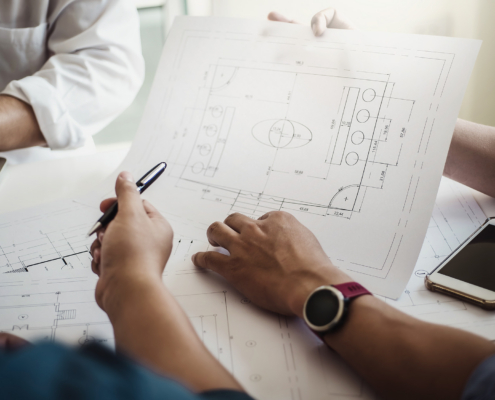
In a design-build model, one entity is responsible for both design and construction under a single contract. Instead of hiring an architect separately and then bidding the project to contractors, the owner engages a unified team from the start.

This structure differs from traditional design-bid-build, where design and construction operate under separate agreements and timelines.

In government building construction, the design-build approach aims to streamline coordination, reduce disputes, and compress schedules all while maintaining compliance with public-sector regulations.

Why Design-Build Is Gaining Popularity in Government Construction Projects

Many agencies are exploring design-build because it addresses common challenges in public projects.

1: Improved Schedule Performance

Government construction projects often operate on strict funding cycles. Delays can jeopardize grants, fiscal allocations, or public commitments.

Design-build allows overlapping phases. While final design details are being completed, early construction activities can begin. This parallel workflow reduces downtime between stages.

For public agencies facing tight occupancy deadlines—such as schools opening before the academic year—this schedule efficiency can be critical.

2: Greater Cost Certainty

Budget overruns on government building construction projects attract public scrutiny. Design-build supports cost control by providing real-time pricing input during the design phase.

Instead of discovering budget gaps after the design is complete, agencies receive continuous cost feedback. This allows adjustments before construction begins.

With fewer change orders and clearer forecasting, public stakeholders gain confidence in financial projections.

3: Single Point of Accountability

Traditional government construction projects sometimes experience disputes between designers and contractors over responsibility. These disagreements can stall progress and create administrative burdens.

Design-build consolidates accountability. One team is responsible for both design and execution. This reduces finger-pointing and simplifies communication for agency leaders overseeing the project.

In a public environment where transparency matters, having a single responsible entity can reduce confusion and keep oversight straightforward.

4: Enhanced Collaboration for Municipal Building Design

Public facilities must balance functionality, durability, safety, and community impact. Whether it’s a fire station, courthouse, or public works facility, municipal building design must meet operational needs while respecting taxpayer investment.

With design-build, builders contribute practical insights during the design stage. This collaboration improves constructability and ensures systems are designed for long-term maintenance.

Early input from experienced government construction contractors often prevents costly redesigns later in the process.

Potential Concerns With Design-Build in Government Construction

While design-build offers advantages, it’s not a universal solution. Public agencies should weigh a few considerations.

Procurement Regulations

Government procurement rules vary by jurisdiction. Some agencies require competitive bidding processes that align more naturally with design-bid-build.

However, many states and federal agencies now allow or even encourage design-build for certain project types. Understanding local statutes is essential before selecting this delivery method.

Perceived Loss of Design Control

Some public officials worry that design-build limits design flexibility. In reality, the owner retains control over performance criteria and design standards.

The difference lies in collaboration. Instead of a fully independent architect, the design team works alongside builders to align design intent with budget and schedule constraints.

For government building construction, this can actually enhance quality by ensuring realistic, buildable solutions.

Transparency and Public Accountability

Public-sector projects must remain transparent. Clear documentation, defined scope, and open communication are non-negotiable.

Design-build can support transparency when contracts clearly define responsibilities, performance metrics, and reporting standards. Agencies must ensure procurement and oversight processes are structured properly.

When Design-Build Makes the Most Sense for Government Building Construction

Design-build often works best in the following scenarios:

  • Projects with aggressive timelines
  • Facilities requiring complex coordination (healthcare, labs, public safety)
  • Renovations in active government buildings
  • Projects with defined performance goals but flexible design solutions

For example, upgrading an operational VA facility requires careful coordination to avoid disrupting services. Design-build teams can phase work efficiently while maintaining safety standards.

Similarly, infrastructure improvements tied to federal funding cycles benefit from accelerated schedules.

Interested in learning how a streamlined delivery model can support your next public project? Explore Ironclad’s government building construction services to see how integrated design-build solutions deliver compliance, efficiency, and accountability.

Explore Our Government Construction Services

Risk Management in Government Construction Projects

Risk management is central to successful government construction projects. From site conditions to material volatility, public agencies must anticipate potential challenges.

Design-build helps manage risk by:

  • Identifying constructability issues early
  • Integrating cost analysis into design decisions
  • Reducing contract conflicts
  • Streamlining communication channels

This proactive approach shifts coordination risk away from the agency and toward the integrated team. For public leaders, this means fewer surprises and more predictable outcomes.

The Role of Government Construction Contractors

Not every contractor is equipped for public-sector work. Experienced government construction contractors understand:

  • Federal acquisition regulations: They are familiar with procurement frameworks, contract clauses, and reporting requirements that govern federally funded projects.
  • OSHA compliance requirements: Public-sector construction demands rigorous adherence to workplace safety standards, with proactive safety programs and documented enforcement.
  • Certified payroll reporting: Contractors must accurately track and submit wage documentation to demonstrate compliance with prevailing wage laws.
  • Security and access control protocols: Many government sites require background checks, restricted access procedures, and coordination with security personnel to protect sensitive operations.
  • Documentation and audit readiness: Public projects are subject to audits and oversight reviews, requiring organized recordkeeping and consistent reporting throughout the build.

When evaluating design-build for government building construction, selecting a team with deep public-sector experience is critical. Government projects demand a level of precision and oversight that differs from private development.

Balancing Innovation With Public Responsibility

Public facilities must stand the test of time. They serve communities, employees, and citizens for decades. Design-build supports innovation without sacrificing responsibility. By integrating planning, engineering, and construction under one umbrella, agencies can:

  • Reduce duplication of effort
  • Improve sustainability performance
  • Enhance lifecycle efficiency
  • Deliver facilities that meet operational needs from day one

For municipal building design, this integration often leads to better alignment between infrastructure investments and long-term public benefit.

Design-Build vs. Traditional: A Strategic Decision

Choosing between design-build and design-bid-build isn’t about trends, it’s about strategic fit.

Traditional models may suit highly standardized projects with minimal schedule pressure. But for many modern government building construction initiatives, the integrated nature of design-build offers meaningful advantages.

Public agencies must consider:

  • Timeline sensitivity
  • Budget constraints
  • Regulatory environment
  • Internal staffing resources
  • Project complexity

When speed, coordination, and cost control are priorities, design-build often proves to be the smarter approach.

Looking Ahead: The Future of Government Building Construction

As public infrastructure demands grow, delivery models will continue evolving. Budget pressures, aging facilities, and rising community expectations require efficiency and accountability.

Design-build is becoming a key tool in addressing these challenges. For many government construction projects, it offers a balanced approach, combining collaboration, compliance, and financial discipline.

Ultimately, the decision should align with the project’s scope, regulatory framework, and long-term public impact.

Support Your Next Public Facility With the Expertise it Demands

Government building construction requires precision, transparency, and a deep understanding of public-sector standards. If your agency is evaluating delivery methods for an upcoming project, Ironclad brings extensive experience in government construction projects and integrated design-build solutions. Reach out today to discuss how our team can support your next public facility with the accountability and expertise it demands.

Share This Post

  • Share on Facebook
  • Share on X
  • Share on Pinterest
  • Share on LinkedIn
  • Share on Tumblr
  • Share on Vk
  • Share on Reddit
  • Share by Mail

More Like This

Understanding Design-Build Timelines: What Happens and When

Design-Build
https://www.ironcladservices.com/wp-content/uploads/2026/03/Design-Build-Project-Timeline.jpg 1250 2000 Abstrakt Marketing /wp-content/uploads/2022/11/IroncladlogoBW-300x74.png Abstrakt Marketing2026-03-23 11:10:492026-03-23 11:10:54Understanding Design-Build Timelines: What Happens and When

The Top 7 Reasons Developers Prefer Design-Build Services for Commercial Projects

Commercial Construction, Design-Build
https://www.ironcladservices.com/wp-content/uploads/2026/03/Why-Developers-Prefer-Design-Build-Services.jpg 1250 2000 Abstrakt Marketing /wp-content/uploads/2022/11/IroncladlogoBW-300x74.png Abstrakt Marketing2026-03-04 16:36:102026-03-04 16:37:21The Top 7 Reasons Developers Prefer Design-Build Services for Commercial Projects

Regional Construction Considerations for Design-Build Projects in New England

Design-Build
https://www.ironcladservices.com/wp-content/uploads/2026/03/Regional-Construction-Considerations-for-Design-Build-Projects-in-New-England.jpg 1250 2000 Abstrakt Marketing /wp-content/uploads/2022/11/IroncladlogoBW-300x74.png Abstrakt Marketing2026-03-04 10:20:202026-03-04 10:20:25Regional Construction Considerations for Design-Build Projects in New England

How the Design-Build Delivery Method Reduces Risk for Business Owners

Design-Build
https://www.ironcladservices.com/wp-content/uploads/2026/02/How-the-Design-Build-Delivery-Method-Reduces-Risk-for-Business-Owners.jpg 1250 2000 Abstrakt Marketing /wp-content/uploads/2022/11/IroncladlogoBW-300x74.png Abstrakt Marketing2026-02-09 09:07:202026-02-09 09:07:57How the Design-Build Delivery Method Reduces Risk for Business Owners
Construction team shake hands greeting start new project plan

Tips for Choosing a Design Build Firm

Contractor Selection, Design-Build
https://www.ironcladservices.com/wp-content/uploads/2025/09/Construction-team-shake-hands-greeting-start-new-project-plan.jpg 1250 2000 Abstrakt Marketing /wp-content/uploads/2022/11/IroncladlogoBW-300x74.png Abstrakt Marketing2025-09-24 13:01:002025-09-24 13:01:06Tips for Choosing a Design Build Firm
Previous Previous Previous Next Next Next

Categories

  • Commercial Construction
  • Commercial Restoration
  • Construction Scheduling
  • Contractor Selection
  • Damage Assessment
  • Design-Build
  • Disaster Recovery
  • Emergency Restoration Services
  • ESG
  • General Contracting
  • Masonry
  • Pre Construction
  • Regional Strategy
  • Remodel / Renovations
  • Risk Management
  • Safety
  • Uncategorized

Contact Us

"*" indicates required fields

Location

Address

1500 Main St., Suite 2004
Springfield, MA 01115


Get In Touch

Phone
413.693.1371

Email
builders@ironcladservices.com

Construction Services

General Contracting

Construction Management

Design-Build

Ground-Up

Renovations

Emergency Restorations

About Us

Ironclad Services is a full-service commercial construction contractor headquartered in Springfield, Massachusetts. We bring the same level of precision, safety, craftsmanship, and quality to private sector projects large and small as we do the federal contracting work that our reputation was built on.

Learn More
Website by Abstrakt Marketing Group ©
  • Sitemap
  • Privacy Policy
  • LinkedIn
Link to: The Top 7 Reasons Developers Prefer Design-Build Services for Commercial Projects Link to: The Top 7 Reasons Developers Prefer Design-Build Services for Commercial Projects The Top 7 Reasons Developers Prefer Design-Build Services for Commercial P... Link to: Understanding Design-Build Timelines: What Happens and When Link to: Understanding Design-Build Timelines: What Happens and When Understanding Design-Build Timelines: What Happens and When
Scroll to top Scroll to top Scroll to top

This site uses cookies. By continuing to browse the site, you are agreeing to our use of cookies.

AcceptLearn more

Cookie and Privacy Settings


How we use cookies

We may request cookies to be set on your device. We use cookies to let us know when you visit our websites, how you interact with us, to enrich your user experience, and to customize your relationship with our website.

Click on the different category headings to find out more. You can also change some of your preferences. Note that blocking some types of cookies may impact your experience on our websites and the services we are able to offer.

Essential Website Cookies

These cookies are strictly necessary to provide you with services available through our website and to use some of its features.

Because these cookies are strictly necessary to deliver the website, refusing them will have impact how our site functions. You always can block or delete cookies by changing your browser settings and force blocking all cookies on this website. But this will always prompt you to accept/refuse cookies when revisiting our site.

We fully respect if you want to refuse cookies but to avoid asking you again and again kindly allow us to store a cookie for that. You are free to opt out any time or opt in for other cookies to get a better experience. If you refuse cookies we will remove all set cookies in our domain.

We provide you with a list of stored cookies on your computer in our domain so you can check what we stored. Due to security reasons we are not able to show or modify cookies from other domains. You can check these in your browser security settings.

Other external services

We also use different external services like Google Webfonts, Google Maps, and external Video providers. Since these providers may collect personal data like your IP address we allow you to block them here. Please be aware that this might heavily reduce the functionality and appearance of our site. Changes will take effect once you reload the page.

Google Webfont Settings:

Google Map Settings:

Google reCaptcha Settings:

Vimeo and Youtube video embeds:

Accept settingsHide notification only